
For people working in export control, the real concern is rarely theoretical.
The practical fault lines are usually:
- Have we classified the item correctly?
- Could this shipment require a licence?
- Are we comfortable with the end-user, destination, and intended use?
- If our assessment is challenged later, can we prove we got it right?
This uncertainty is normal. Customs is often associated with imports (duties, declarations, and border clearance), while exports were traditionally treated as lower-friction unless goods were obviously military. That picture changed. In 2026, export control is a core business process.
Today, export control has moved from a pure security instrument to a central part of economic statecraft. High-end semiconductors, dual-use software, rare-earth components, and sensitive chemicals can all trigger complex checks.
What is export control?
Export control governs transfers of goods, software, and technology across borders for national security, foreign policy, and non-proliferation reasons.
General customs rules mainly focus on fiscal treatment (tariffs, VAT, duties). Export control focuses on strategic significance and transaction risk.
In practice, export controls target three objectives:
- National security: prevent sensitive capabilities from strengthening risky actors.
- Non-proliferation: stop materials, software, and know-how from supporting weapons programs.
- Foreign policy and human rights: enforce restrictions where security or rights risks are significant.
The dual-use challenge in 2026
Most operational complexity sits in dual-use trade. These are items that look civilian but can also be used in military, surveillance, or proliferation contexts.
A product does not need to look military to be controlled. It can be an industrial component, software module, or technical material that meets specific thresholds.
For EU exporters, Annex I of Regulation (EU) 2021/821 remains central, and updates continue to reflect technology shifts.
In 2026, risk also extends to intangible transfers:
- technical files sent by email
- remote software access
- design uploads to cloud platforms
- technical support that transfers controlled know-how
No physical shipment is required for a compliance breach.
The four pillars every EU exporter should know
- Regulation (EU) 2021/821 for dual-use items and catch-all controls.
- EU Common Military List for military technology references.
- National licensing and enforcement at member-state level.
- Sanctions and embargo overlap in real transaction screening.
Export control is therefore not a single-list exercise. It is layered analysis across product, party, geography, and use case.
Beyond military high-tech: the triple-gate model
A practical model for export control screening:
- Gate 1 (What): Is the product controlled? (classification)
- Gate 2 (Who): Is the counterparty or owner restricted? (sanctions / UBO)
- Gate 3 (How): Is there digital transfer or diversion exposure? (ITT / rerouting)
This is where modern AI export control workflows add value by structuring checks consistently.
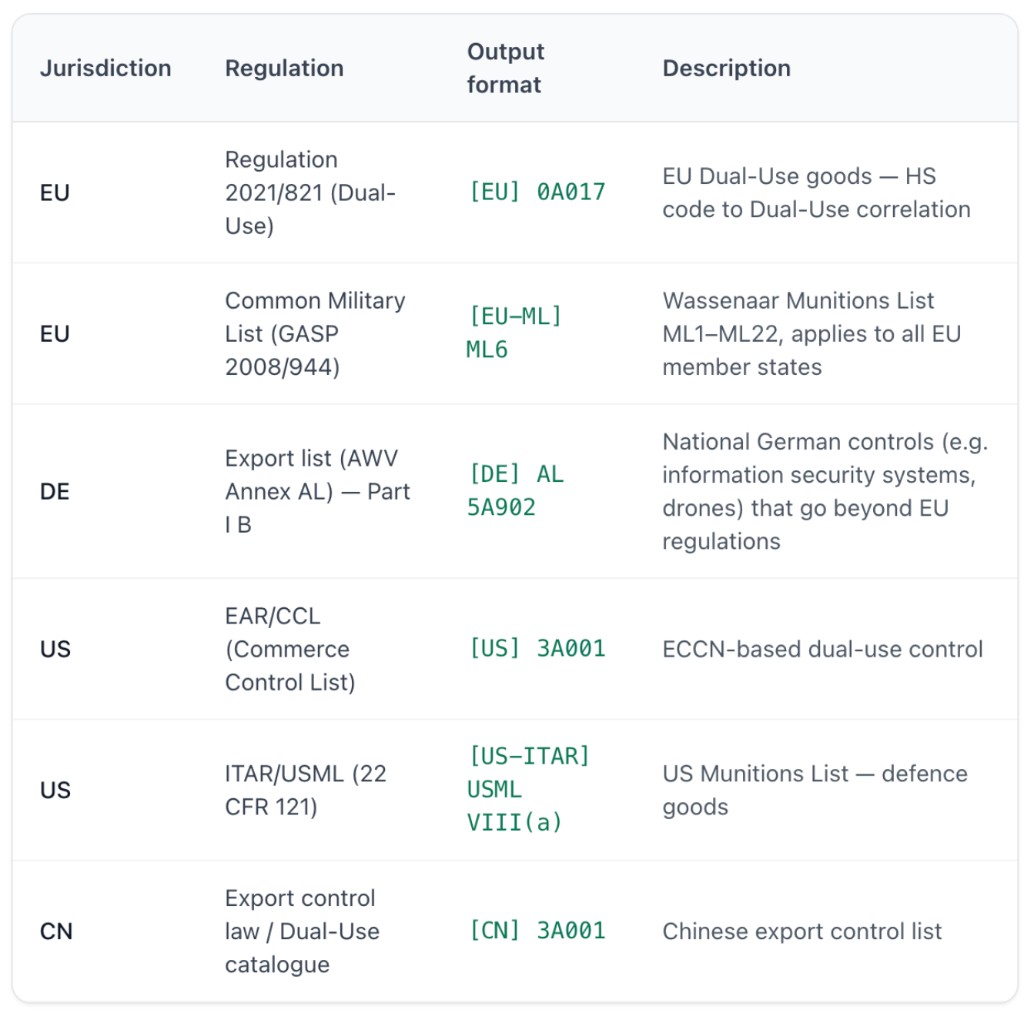
Supported export control lists at Digicust
In practice, export control reviews often span multiple frameworks in the same transaction. Digicust supports list-level correlation across EU dual-use, military, national, and non-EU regimes to improve consistency in first-level triage.
Case study: AI-driven export control check for DJI Matrice 350 RTK
Scenario:
- Exporter: Germany-based distributor
- Product origin: China
- Product: DJI Matrice 350 RTK
- Destination: Turkey
- End-use: industrial inspection and surveying
Step 1: Data extraction
The platform captures technical signals from product and shipment documents:
- flight endurance
- transmission range
- payload capacity
- positioning capability
- autonomous features
- takeoff weight
Step 2: Classification support
The system performs first-level correlation against applicable control frameworks and flags non-routine profiles for specialist review.
Step 3: Party screening
The workflow screens exporter, buyer, manufacturer, and linked entities. This is the operational core of robust export control screening.
Step 4: Destination and end-use risk
Turkey and Russia can produce very different outcomes for the same product profile. Destination context materially changes legal exposure.
Step 5: Escalation logic
AI should accelerate low-risk cases and escalate higher-risk transactions early, with clear rationale.
Step 6: Audit trail
A defensible process records:
- extracted product attributes
- control-list signals
- party-screening results
- destination/end-use findings
- escalation and final recommendation
Why this matters for operations teams
Manual-only workflows struggle with speed, consistency, and evidence quality. AI for import export business teams is most effective when paired with legal expertise, not used as a legal replacement.
Many teams evaluating ecommerce import/export compliance software AI are not looking for flashy dashboards. They need faster triage, better data quality, and audit-ready records.
Final thoughts
In 2026, export control is no longer a niche discipline. It affects businesses handling advanced technology, software, electronics, chemicals, and high-risk know-how.
The winning model combines legal judgment with operational automation:
- classify consistently
- screen parties deeply
- evaluate destination and diversion risk
- document decisions for future challenge
That is how companies build export control programs that are fast enough for business and rigorous enough for regulators.
Solution preview


