
Latest Insights on Customs & AI
Stay updated with the latest trends, best practices, and innovations in customs automation and international trade.
Optimisation of customs processes at ZLS
How ZLS Logistik Service achieved a 90% reduction in processing time and 70% cost reduction through Digicust's AI-powered automation solution.

Digitization of customs processes at Wackler Spedition & Logistik
How a 175-year-old family business achieved 64% processing time reduction and automated 16,000 customs declarations in just 3 months.
The Complete Guide to HS Code Classification in 2026
When people think about international trade, they often imagine containers, customs officers, and endless paperwork. What they rarely see is the hidden backbone of global commerce: HS code classification. In 2026 this task has become even more important. Customs authorities around the world are tightening rules, increasing audits, and enforcing stricter penalties for incorrect declarations. At the same time, supply chains have accelerated — leaving less time for manual checks and second guesses. The good news? With the right understanding, and today even with the help of AI tools, classification doesn't need to be intimidating or unpredictable. This guide walks you through everything from the basics to advanced techniques, including a real example that illustrates how classification works in practice. ## What Is an HS Code? An HS Code (Harmonised System Code) is a global 6-digit product classification used by customs authorities to determine: * Import duties * VAT and excise * Export control requirements * Trade statistics * Country of origin treatment * Risk profiles for customs clearance More than 200 countries and economies use the HS as the basis for their tariff systems — making it one of the most influential regulatory standards in the world. ## HS Codes, Harmonised Codes & Tariff Codes — What's the Difference? People often use these terms interchangeably, and it causes confusion. Here's how they actually relate: **HS Code** — Global 6-digit standard by the WCO **Harmonised Code** — Same as HS code **Tariff Code** — Country-specific extension beyond 6 digits **Commodity Code** — EU/UK name for tariff codes **CN Code** — EU 8-digit "Combined Nomenclature" **TARIC Code** — EU 10-digit tariff code **HTS Code** — U.S. 10-digit Harmonized Tariff Schedule Most countries take the global HS and extend it further. **Example for filled chocolate bars:** * HS (6-digit) → 180631 * EU CN (8-digit) → 18063100 * EU TARIC (10-digit) → 1806310000 National systems may even add statistical digits beyond that. ## How the Global HS System Works The HS system has four main layers: * 21 Sections * 97 Chapters * Over 1,200 headings * More than 5,000 subheadings A typical structure looks like this: * 18 → Chapter (Cocoa) * 1806 → Heading (Chocolate & cocoa preparations) * 180631 → Subheading (Chocolate, filled) Countries then extend the code depending on their tariff system. ## The Six General Rules of Interpretation (GRI) The GRI rules are the legal foundation for HS classification. Every classifier — whether a customs officer or AI system — must apply them in order. Here's the human-friendly version: ### GRI 1 — Start With the Obvious Stuff You must begin with: * Section Notes * Chapter Notes * Heading descriptions If the wording clearly fits the product, the job is almost done. ### GRI 2 — Don't Be Fooled by Incomplete or Mixed Items Covers: * Items that aren't fully assembled yet * Items missing minor components * Mixed materials If something still has its essential character, it stays in the same area of the tariff. ### GRI 3 — When More Than One Heading Seems Possible This rule feels like real-world decision-making: * The more specific description wins. * If that doesn't settle it → essential character. * If still tied → choose the heading that appears later in numerical order. ### GRI 4 — The "Closest Match" Rule If nothing fits perfectly, classify the item as something most similar. Used rarely, but it exists for edge cases. ### GRI 5 — Packaging Rules Some packaging is classified with the product (like camera cases), others aren't. ### GRI 6 — Apply All Rules Again at Subheading Level Everything you did at heading level must be repeated when choosing between subheadings. ## Case Study: Classifying "Dubai Chocolate" This example makes classification more tangible and comes from a real AI demonstration. Below, you can see the Digicust Digital Customs platform in action, classifying "Dubai Chocolate" using our AI assistant: 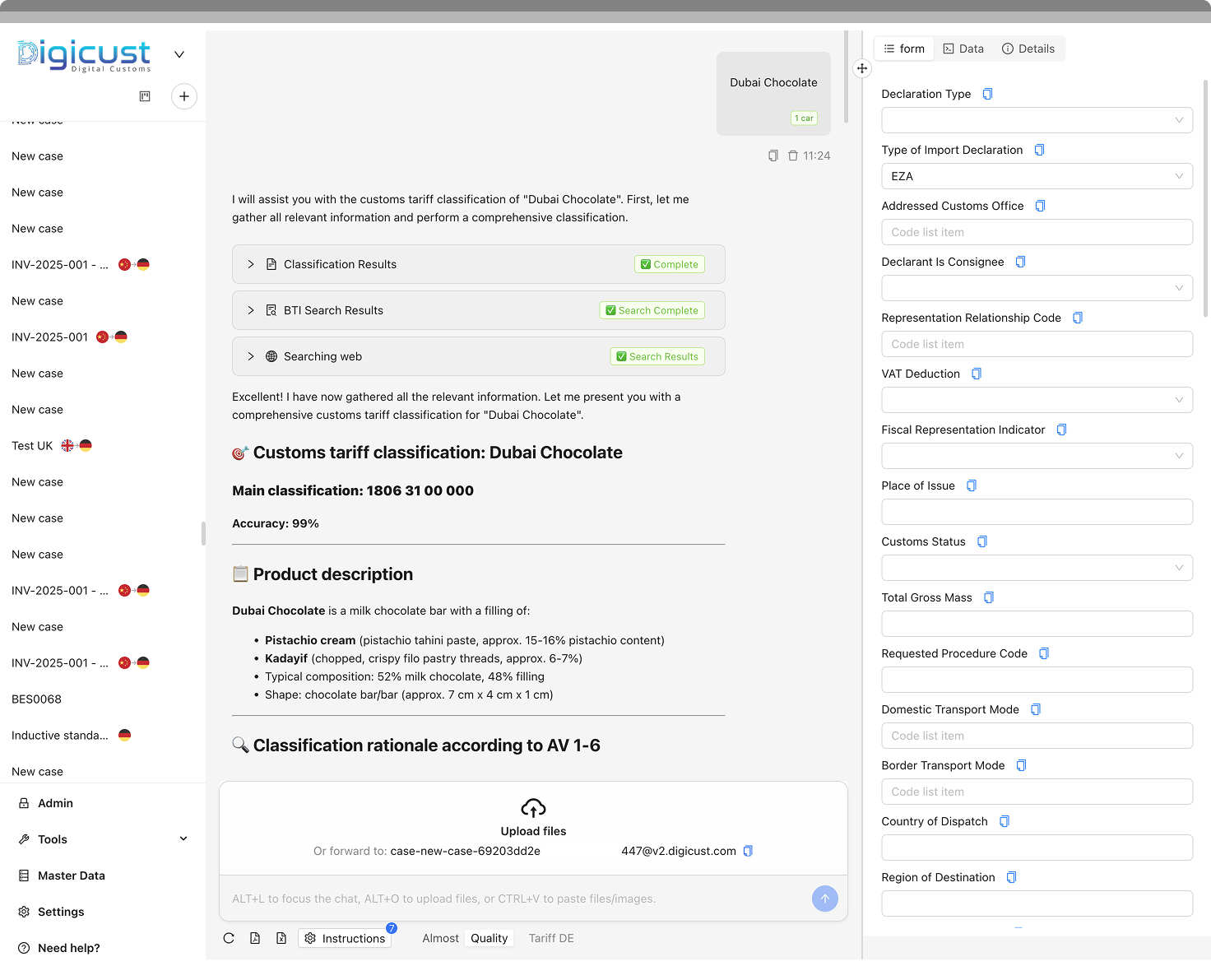 *The Digicust Digital Customs platform showing AI-powered classification of "Dubai Chocolate" with 99% accuracy. The interface includes an AI chat assistant, classification results, BTI search results, and a comprehensive customs declaration form.* The product contains: * Milk chocolate coating * Pistachio cream * Kataifi pastry strands * Tahini (sesame paste) At first glance, it could fall into several categories. ### Step 1 — Identify Candidate Headings **Heading 1806** — Chocolate & cocoa preparations (might apply) **Heading 1905** — Bakery products (due to kataifi pastry) **Heading 1704** — Sugar confectionery (only if no cocoa) Because the product contains cocoa, 1704 is ruled out at GRI 1. ### Step 2 — Use GRI 3 (Essential Character) Even though it contains pastry strands, the chocolate coating defines: * the product's taste * its appearance * how it is sold * how it is understood by consumers So under GRI 3(b), chocolate wins over pastry. ### Step 3 — Choose the Correct Subheading Under heading 1806: * The product is filled * It's presented as chocolate confectionery * It meets the format requirements (bars/slabs or similar products) So the correct HS subheading is: **1806.31 — Chocolate, filled** ### Step 4 — Country-specific extensions * EU CN code: 18063100 * Many national systems: 1806310000 * Additional statistical digits may apply depending on country ### External confirmation Independent tariff databases confirm: * 1806.31 = filled chocolate products * EU CN (8-digit) 18063100 matches filled chocolate * World Bank WITS trade flows for 180631 correspond to filled chocolates So the logic and the final classification align well with global HS standards. ## The 7 Most Common HS Classification Mistakes From real customs practice, these are the mistakes that cause the most audits, delays, and retroactive duties: 1. **Ignoring Chapter and Section Notes** — These are legally binding and must be checked first. 2. **Choosing a code because it "looks right"** — Classification requires systematic analysis, not intuition. 3. **Copying a supplier's classification without checking** — Suppliers can be wrong, and you're legally responsible. 4. **Using marketing names instead of technical descriptions** — Customs uses technical terminology, not brand names. 5. **Misunderstanding "essential character"** — This is a key concept in GRI 3 that requires careful analysis. 6. **Assuming similar products share the same HS code** — Small differences in composition or form can change classification. 7. **Failing to update classifications when a product changes** — Any change in materials, form, or function may require reclassification. ## How AI Is Transforming HS Classification in 2026 Until recently, tariff classification relied entirely on: * personal expertise * internal notes * trial and error * time-consuming research But in 2026, AI systems can: * read product descriptions * analyze images * extract technical data * search BTI databases * apply GRI rules step by step * draft human-readable justifications This doesn't replace experts — it augments them. AI handles the heavy lifting, and humans make the final call for borderline cases. ## AI Tariff Classification at a Glance Modern AI classification systems (like Digicust's Taric Classifier) typically offer: 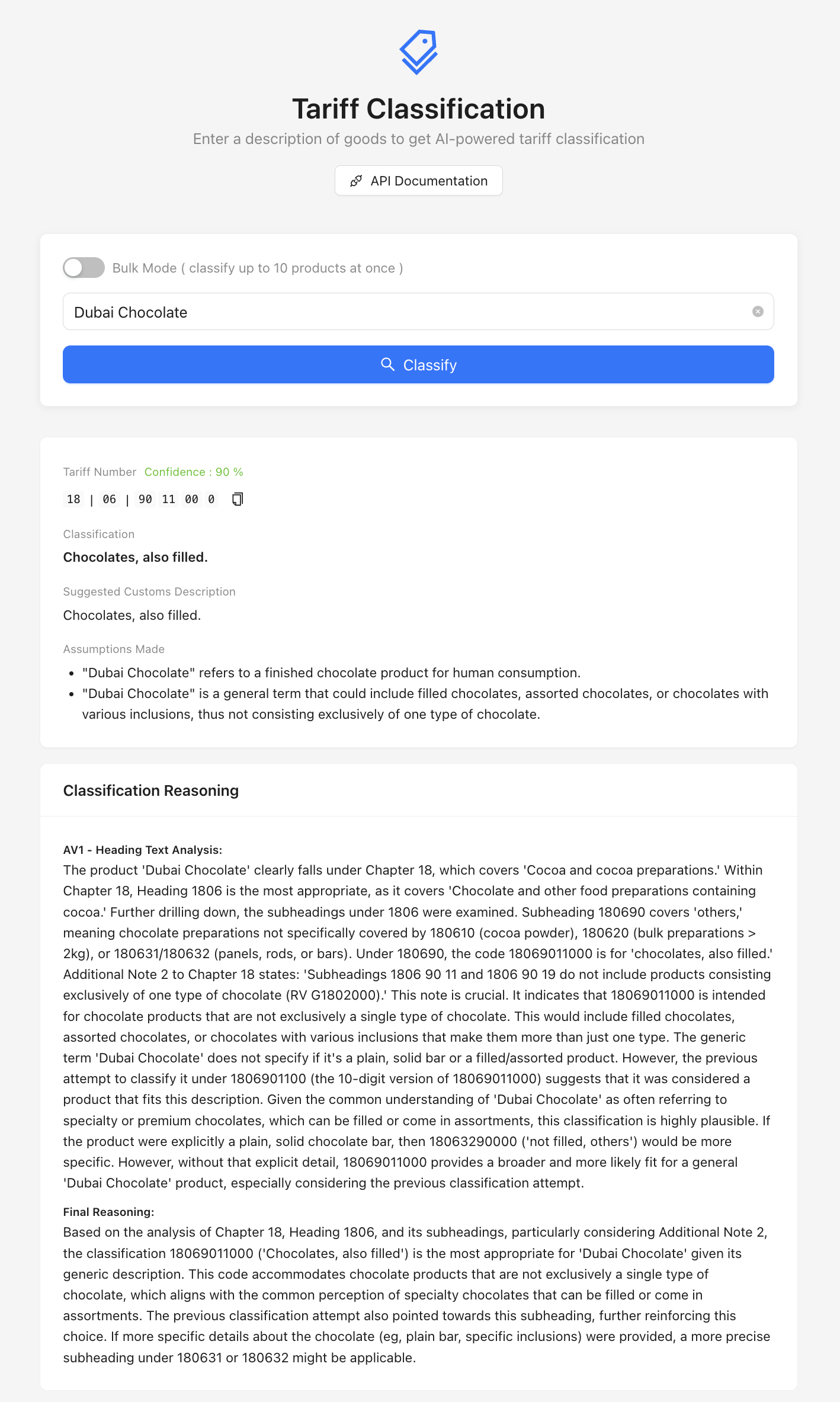 *The Digicust Tariff Classification web tool provides instant AI-powered classification with detailed reasoning. Simply enter a product description to receive accurate HS code classification with confidence scores and GRI-based explanations.* * High accuracy based on large training corpora * Automatic BTI case matching * Image-based classification support * GRI-reasoning explanations * Country-specific tariff extension support * Bulk processing for catalogs * Confidence scoring * Audit trails showing how each decision was made * Integration with customs software and ERPs The key benefit in daily operations is consistency. AI doesn't get tired, doesn't skip steps, and doesn't rush through classifications — which makes it a valuable partner for customs teams. ## Best Practices for Accurate HS Classification 1. **Start with official notes, not guesses** — Always check Section and Chapter Notes first. 2. **Apply GRI rules in the correct order** — GRI 1 through 6 must be applied sequentially. 3. **Use technical data, not marketing language** — Focus on composition, function, and form. 4. **Check BTI decisions for guidance** — While not binding for your product, they show how customs interprets similar items. 5. **Document your reasoning every time** — This creates an audit trail and helps with future classifications. 6. **Revisit classifications when materials change** — Even minor changes can affect the code. 7. **Consider using AI for bulk or repetitive tasks** — AI excels at consistent, high-volume classification work. ## FAQ ### Is the HS code the same in every country? Only the first 6 digits are globally harmonised. Everything beyond that differs by country. ### Can a product have more than one HS code? No. It must have one correct code, even if multiple ones seem possible at first. ### Is classification a legal obligation? Yes. Incorrect classification can lead to retroactive duties, penalties, or shipment stops. ### Are BTI rulings binding? Only for the company that requested them, but they are helpful for understanding how customs may interpret similar products. ### Can AI replace human classifiers? AI can automate the heavy research work, but humans remain essential for edge cases and compliance interpretation. ## Final Thoughts HS classification is sometimes seen as bureaucratic, but at its core it's a form of problem-solving. You take a product, understand what it truly is, follow a globally agreed set of rules, and arrive at a legally sound result. In 2026, with more complex supply chains and tighter regulations, combining human expertise with the speed and consistency of AI creates a more reliable, less stressful classification process. It helps teams focus on the parts of customs work that require judgment and experience — while giving routine classification a level of structure and transparency that simply wasn't possible before.
Digicust to Expand AI Agents for Customs to Belgium and the Netherlands
Digicust, an Austrian deep tech startup and pioneer in AI agents for customs automation, has announced plans to launch its innovative AI agents for customs clearance in Belgium and the Netherlands by the end of 2025. This strategic initiative is being carried out in parallel with an in-depth market study to gain a thorough understanding of market dynamics and customer requirements in Belgium. ## Strategic Expansion Supported by aws Program Support for the expansion comes from the Austria Wirtschaftsservice (aws) "aws Technologie-Internationalisierung Programm" which highlights the strategic importance and innovative potential of this initiative. After a highly successful market entry in Germany last year, Digicust is now positioning itself strategically to become the leading provider of AI agents for customs clearance solutions. ## Leadership Vision for European Market Dominance "Expanding into Belgium and the Netherlands is the logical next step in our growth journey," said **Borisav Parmakovic, CEO of Digicust**. "These markets are strategically vital due to their role as major European gateways for international trade. Our advanced AI customs agents streamline processes, significantly reduce errors, and provide substantial cost savings, positioning our clients at the forefront of customs digitization." ## Comprehensive Market Analysis Strategy The concurrent market study is led by **Bernhard Klug**, who emphasized: "Our comprehensive analysis is not just about understanding market conditions; it's about actively engaging with potential customers and partners from day one." ## Advanced AI Technology Capabilities Digicust's AI agents automate complex customs processes including: ### Core Automation Features - **Complex customs documentation** - Automated generation and validation - **Tariff classification** - AI-powered HS code determination - **Compliance checks** - Real-time regulatory validation - **Fraud detection** - Advanced pattern recognition and risk assessment ### Operational Benefits - **24/7 customs clearance** - Continuous processing capabilities - **Drastically reduced manual workloads** - Up to 30% efficiency improvements - **Increased operational efficiency** - Streamlined workflow automation - **Enhanced security** - Advanced threat detection and prevention - **Improved supply chain speed** - Faster processing and clearance times ## Seamless Integration Advantage This cutting-edge technology integrates seamlessly into existing software solutions, offering rapid adoption and immediate benefits for businesses of all sizes. ## Strategic Market Positioning Belgium and the Netherlands represent critical European trade hubs, making them ideal markets for Digicust's expansion strategy. The countries serve as major gateways for international commerce, with significant volumes of customs declarations and complex trade requirements that can benefit from AI automation. ## Future Outlook This expansion represents a significant milestone in Digicust's journey to become the leading AI customs automation provider across Europe. The success in Germany has provided valuable insights and proven market demand for intelligent customs solutions. ## About Digicust FlexCo Founded in 2020 and headquartered at Vienna Airport, Digicust is revolutionizing customs clearance through AI-powered solutions, enabling businesses to automate, simplify, and accelerate customs processes with unmatched accuracy and efficiency. --- **Press Contact:** Bernhard Klug, MSc – Head of Marketing Email: marketing@digicust.com Website: www.digicust.com
TÜV SÜD issues certificate for ethically responsible Artificial Intelligence applications to Digicust
**Munich/Vienna.** Experts at international testing, inspection and certification (TIC) company TÜV SÜD have issued their first certificate for an ethically responsible application with Artificial Intelligence (AI) to the Austrian logistics startup Digicust GmbH. The IEEE CertifAIEdTM is an international certification scheme that assesses the ethical responsibility of existing AI systems. "This voluntary certification by TÜV SÜD highlights Digicust's goal of designing an AI application that is demonstrably fairer and more trustworthy and goes beyond the requirements imposed by law," says Philipp Coution, Head of AI Quality at TÜV SÜD, who carried out the audit at Digicust. Digicust offers innovative solutions for digitalizing and automating customs clearance for industry and logistics companies, an area where ethical aspects are highly relevant to prevent the import of any unsafe or non-complying products. Ahmad Haj Mosa, PhD, co-founder of Digicust und Chief of Innovation and AI, explains: "This certification ensures that our AI solutions are trustworthy and in line with the applicable safety standards. This in turn strengthens the trust of our customers and business partners over the long term." ## Certification is culmination of one-year process TÜV SÜD carried out the first AI assessment in accordance with ethical criteria. Completed in summer 2024, the roughly one-year process covered assessment of both the technical features and, in particular, the ethical aspects of AI. The certification procedure was based on the CertifAIEd assessment, which considers criteria such as accountability, privacy, algorithmic bias, and transparency. ## First international certification scheme IEEE CertifAIEdTM is a certification scheme for assessing the ethics of AI applications and raising their acceptance. The certification criteria were derived from the IEEE 7000-2021, the first international standard to consider ethical aspects in the development and use of AI systems. The criteria address many ethical aspects of the development and use of autonomous intelligent systems (AIS). The resulting certificate and certification mark provide proof to users of the organization's efforts to offer trustworthy solutions. ## Companies frequently at a loss While AI applications are widely known and used, they frequently fail to address ethical aspects. Even where ethical criteria have been defined, their implementation in assessment criteria is difficult and depends on many factors. The EU AI Act stipulates that ethical requirements must be considered in AI applications from an early stage. IEEE CertifAIEdTM sets out assessment and certification criteria and methods designed to protect AI applications from ethical risks. ## Quality assurance for AI: TÜV SÜD sets standards TÜV SÜD has been addressing the topic of AI for years and sits on committees developing certification criteria for testing and assessing products with artificial intelligence. These applications are already used and tested in real life in areas such as automated driving and medical devices as well as in consumer and business solutions.
Customs software and pre-customs software
At its core, we offer pre-customs software that minimizes the manual process of customs clearance. Our software works with all major customs software systems, such as LDV customs software, dbh customs software and many other providers. When used with customs software, Digicust takes over the manual work by reading and classifying the customs documents and creating a finished customs declaration. Like an extra employee in your customs processing. ## How does AI contribute to automation in customs clearance? AI enables hyper-automation in customs processing. This means: * **Intelligent document processing**: automatic completion of customs declarations from various documents such as invoices and packing lists. * **AI-supported customs tariff classification**: Automatic determination of customs tariff numbers, other customs codes and other relevant data for the customs declaration * **No-code automation**: User-friendly tools for automating specific customs processes without programming knowledge. * **Integration with leading customs software providers**: Seamless cooperation with providers such as AEB, Dakosy, dbh, LDV and BEO. * **Support for various customs procedures**: Handling of import, export, Intrastat and other procedures ## How can the use of AI-powered customs agents improve the efficiency of the customs process? The use of AI-supported customs agents offers numerous advantages: * **Automation of repetitive tasks**: Reduction of manual labor and human error. * **Seamless integration** with existing customs software systems * **Improved accuracy**: Precise analysis of data leads to correct customs codes and tariff numbers. * **Optimized processes**: Merging data from multiple sources to identify effective processes. * **Increased efficiency**: time and cost savings through automated customs declarations. * **Scalability**: Adapt to growing business volumes without sacrificing accuracy or efficiency. At Digicust, we are committed to continuously developing our AI technologies to provide our customers with the best possible solutions for their customs processing. Contact us today to learn more about our products and services and how Digicust can help your business. ## Expansion and progress As a leading provider of artificial intelligence (AI)-based customs solutions, Digicust is constantly striving to revolutionize customs processing for businesses worldwide. In this post, we'll take an in-depth look at how our advanced AI technologies are shaping the future of customs software. ## The evolution of customs clearance: from manual to automated Traditionell war die Zollabwicklung ein zeitaufwändiger und fehleranfälliger Prozess, der eine Menge manueller Arbeit erforderte. But with the advent of AI-powered customs agents, this situation can change fundamentally. Intelligent document processing and automatic customs tariff classification will speed up processes, minimize errors and save costs. ## A short to medium-term outlook for the future At Digicust, we are only at the beginning of our journey. We will continue to invest in developing and improving our AI technologies to make customs processing even easier, faster and more cost-efficient for businesses. Especially in the areas of: * Automatic completion of customs declarations based on various data sources (ERP, TMS systems, a variety of different document types in PDF, JPG, XLSX format, copy templates, master data, customs software data and feedback data from customs declarants), * Machine-generated, declarable and binding customs tariff information (BTI), * Checks of existing customs tariff numbers, * Compliance checks, sanction list checks, supplier declarations, * Optimization of incorrect data and data quality, * Fraud detection, document control and automatic requests for qualitative, structured data to increase the level of automation. ## Contact us today If you would like to learn more about how Digicust can help your company optimize customs processing, please do not hesitate to contact us. Our experienced team is always available to answer your questions and develop customized solutions for your individual requirements.
Showing 6 of 18 articles